
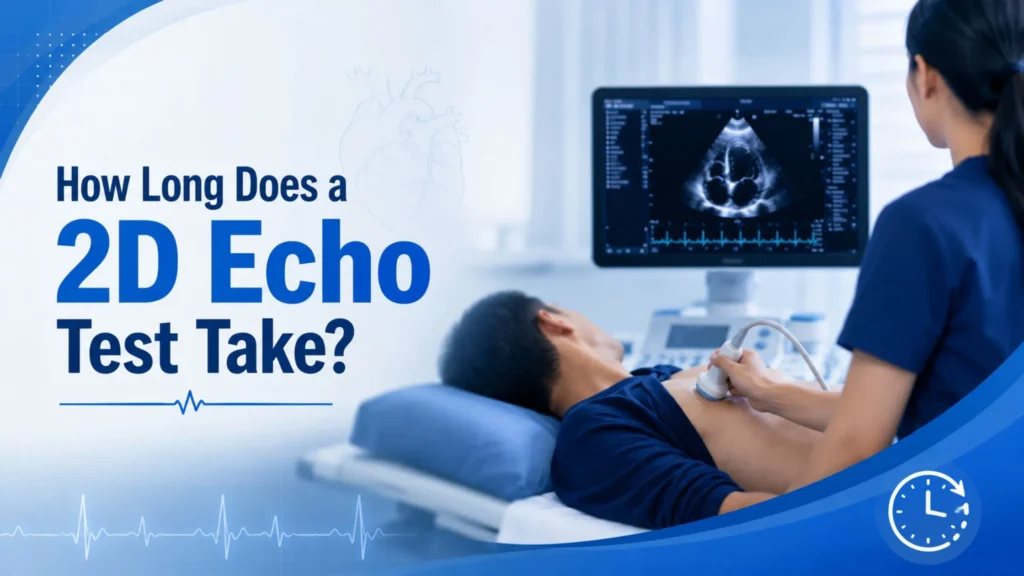
Understanding how long does a 2D Echo test take can help patients feel more comfortable and prepared before their heart evaluation. A 2D echocardiogram is a safe and non-invasive imaging procedure used to assess heart structure, blood flow, and overall cardiac function using ultrasound technology.
Many individuals undergoing this test are often concerned about the duration of the procedure and whether it requires special preparation or recovery time. Learning how long does a 2D Echo test take can reduce anxiety and provide clarity about the entire diagnostic process.
The test is commonly recommended for individuals experiencing chest discomfort, shortness of breath, irregular heartbeat, or those requiring preventive heart screening. Since it offers detailed real-time images of the heart, it has become one of the most widely used cardiac diagnostic tools.
Table of Contents
- What is a 2D Echo Test
- How Long Does a 2D Echo Test Take
- What Happens During the Procedure
- Preparation Before the Test
- Factors That Affect Test Duration
- Benefits of the Test
- Is the Procedure Painful
- What Happens After the Test
- When is the Test Recommended
- Tips for a Smooth Experience
- Conclusion
1. What is a 2D Echo Test
A 2D echo test is an ultrasound-based imaging technique used to evaluate the heart in real time. It helps doctors assess:
- Heart chambers
- Heart valves
- Blood circulation
- Pumping function
The procedure is safe, painless, and does not involve radiation exposure.
2. How Long Does a 2D Echo Test Take
One of the most common patient concerns is how long does a 2D Echo test take. In most cases, the procedure takes approximately twenty to thirty minutes.
However, the exact duration may vary depending on:
- Patient condition
- Image clarity
- Complexity of evaluation
- Additional imaging requirements
Despite these variations, the test is generally quick and convenient.
3. What Happens During the Procedure
Understanding how long does a 2D Echo test take becomes easier when patients know what happens during the procedure.
During the test:
- The patient lies comfortably on an examination bed
- A gel is applied to the chest area
- A transducer is moved gently over the chest
- Ultrasound images appear on a monitor in real time
The technician captures different views of the heart for detailed evaluation.
4. Preparation Before the Test
Most patients asking how long does a 2D Echo test take also want to know about preparation requirements.
Usually, very little preparation is needed. Patients are commonly advised to:
- Wear comfortable clothing
- Follow specific medical instructions if provided
- Arrive a few minutes early
The procedure is simple and does not usually require fasting.
5. Factors That Affect Test Duration
Several factors can influence how long does a 2D Echo test take.
These include:
- Patient movement during the test
- Difficulty obtaining clear images
- Existing heart conditions
- Additional measurements required
In some situations, the evaluation may take slightly longer for detailed analysis.
6. Benefits of the Test
Understanding how long does a 2D Echo test take also highlights why the procedure is widely preferred.
Benefits include:
- Non-invasive evaluation
- No radiation exposure
- Quick procedure
- Real-time heart imaging
- Accurate assessment of heart structure and function
The test provides valuable information for early diagnosis and monitoring.
7. Is the Procedure Painful
Many patients wondering how long does a 2D Echo test take also ask whether the test is painful.
The procedure is generally painless and comfortable. Patients may only feel mild pressure when the transducer is moved across the chest.
Since no needles or surgery are involved, the test is considered very safe.
8. What Happens After the Test
After learning how long does a 2D Echo test take, patients are often relieved to know that recovery time is minimal.
Once the procedure is complete:
- The gel is removed from the chest
- Patients can return to normal activities immediately
- Images are reviewed by specialists
Results are usually discussed after proper evaluation.
9. When is the Test Recommended
Knowing how long does a 2D Echo test take can encourage timely heart screening when needed.
The test is commonly recommended for:
- Chest pain
- Shortness of breath
- Irregular heartbeat
- High blood pressure
- Preventive cardiac evaluation
It helps identify abnormalities early and supports effective treatment planning.
10. Tips for a Smooth Experience
Patients concerned about how long does a 2D Echo test take can follow simple steps for a better experience.
Helpful tips include:
- Arrive on time
- Stay relaxed during the procedure
- Follow technician instructions carefully
- Share medical history if needed
These steps can help ensure smooth and accurate imaging.
11. Conclusion
Understanding how long does a 2D Echo test take can help patients feel more confident before undergoing cardiac evaluation. The procedure is quick, safe, painless, and highly effective for assessing heart structure and function.
A 2D echo test plays an important role in early diagnosis, preventive heart care, and monitoring existing cardiac conditions. Since it provides real-time imaging without radiation exposure, it remains one of the most trusted diagnostic methods in modern cardiology.
For additional information about heart health and cardiac screening, you can refer to trusted organizations like the American Heart Association. Regular evaluation and timely diagnosis can support better long-term cardiovascular wellness.